
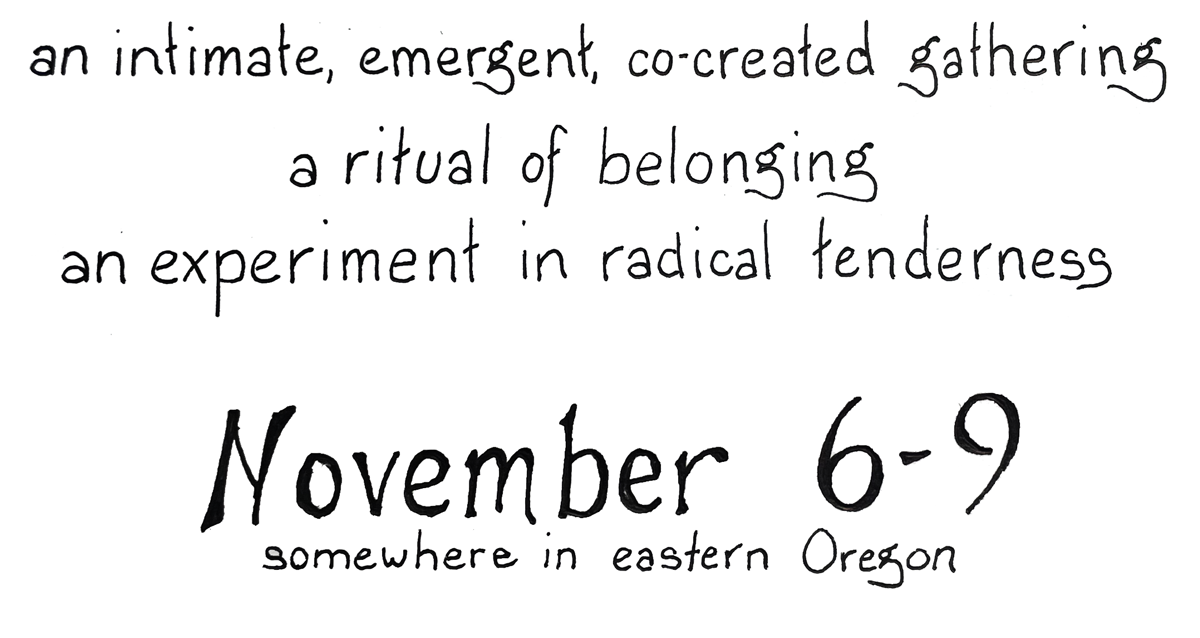

At the heart, Tenderroot is a community experiment in radical cultural integrity, rooted in the ancient technology and wisdom of the Circle, and centered around a shared intention to practice listening deeply—to one another, to the land—in hopes of seeding and nurturing radical visions for a world wholly woven of a web of mutual care.
Let us gather in the Lodge for three days and three nights, in the warmth of open fire, and share meals, share dreams and visions, songs and grief, and revel in our love for the Earth.
What is Tenderroot?
What is the root of our passion, our longing? What is the source of our grief? What are the questions that emerge in the quiet moments when we finally have the space to slow down and listen? These are the questions we hold together in Council.
We are all connected by the root, and through these roots the tendrils of our shared joy and grief mingle and wind together. That which you love, I love. The song you carry in your heart sings also in mine. In turn, that which severs our bonds wounds us. The source of sorrow is disconnection. We wither when uprooted from the Earth.
We gather with deliberate care, because we know, as adrienne marie brown reminds us, “what you pay attention to grows.” We need not be many nor loud for our intentions to flourish.
As the lattice of a crystal must build upon a seed, or a small vibration may resonate to vast reverberations, a single moment may catalyze a whole constellation of possibility. From place to place and season to season, the concentric circles of interconnected possibility converge and spiral together. Patterns repeat. Tendencies emerge.
To nurture our connections and mend the legacy of habitual separation, we must make a practice of tending to the tendencies of our attention. We must make a practice of returning to our shared root.
In our tenderness lies our strength, in our capacity to hear the voices of the many beings around and within us, to whom we belong. To hear, first we must listen, and to listen, first we must trust. It is vulnerable to be receptive. Listening implies risk. The Circle forms the space in which this trust may take root and grow. Let us tend this tender root together.
What is Council?
Perhaps as long as we've been gathering around a central flame, humans have relied on the wisdom of the Circle. This natural, intuitive practice lives bone-deep in our body memories—it is a way of being together, of belonging to a greater shared story, and of remembering our place in the living web of life. In these times of escalating polycrisis, Council is a vital way of returning to the roots of what it means to stand in our shared humanness, and re-sacralize our relationship with the earth and its inhabitants.
Quite simply, Council involves sitting together in a circle taking uninterrupted turns speaking what is true, while others give their full attention. We avoid judging or fixing each other, and we remain curious, compassionate, and confidential. We are guided by four intentions: to speak from the heart, to listen from the heart, to get to the heart of the matter, and to be spontaneous.
On the surface, we are taking turns speaking and listening. Below the surface, what's happening is the emergence of a shared voice, one which is the unique outgrowth of the specific people and circumstances, yet which carries universal significance. More than the sum of our separate voices, we become conduits of that which is spoken through us—we speak from and listen to the heart of this world. We are appointed voices of the Whole. This Whole encompasses an entire ecosystem—one that is all the more resilient in the presence of diversity, dissonance, conflict, and disagreement. There is ample space for incompleteness, for contradiction, for tension, for raw authenticity. We build and expand our capacity to be with what emerges, and stay with it even—and especially—when it becomes challenging.
"Council is an ancient way and modern practice whose roots are deep within the natural world, spanning diverse cultures and spiritual traditions. Sitting in circle, we remember and learn to listen to the whole: the people, the place and all living beings. This practice elicits an experience of deep community, recognizing that each voice has value, every person has a gift, a story to share, a piece of the puzzle."
—School of Lost Borders
We honor Jack Zimmerman and Gigi Coyle, who draw from Native American, classical Greek, and Quaker practices, and who made the Way of Council more accessible to the West. It is because of intact, earth-based cultures—particularly Native American elders who often gathered in Council—that modern humans have the privilege of learning (and remembering) how to gather in this way.
We honor and acknowledge the resilience of these many peoples who—despite genocide, land usurpation, and cultural erasure—continue to demonstrate the power and necessity of this Circle way in keeping stories and traditions alive. May we gather in the spirit of holding, listening to, and voicing the tragedies and beauties of this world.
Seeding Ancient Futures
The Tenderroot mythos
In the Spring, an unmistakable, ethereal blue bespeaks the graceful flowering of the common camas. Tender yet hardy, it speckles the alpine meadows and fertile lowlands of the Pacific Northwest, from California to British Columbia, where it has fed the peoples of these lands since the earliest memories of their ancestors.
In the old days, when the Spring's ephemeral blue gave way to Summer's withered browns, and the flowers gave way to ripened seeds, with ritual procession and antlerbone trowels the people would journey to their ancestral camas meadows to dig the starchy roots and revel in the bounty. It was a time of reunion.
It is said that the bulbs were roasted in pits, and the fire tended for no less than three days and three nights, rendering from the unpleasant, raw bulbs a relished sweetness to be long savored, dried, stored and traded. The soil loosened and pockmarked with trowel holes, the dry seeds were shaken into the moist, open earth, to sow a future harvest. It is said that the more it were dug, the more abundantly the camas would return.
But nature is never without her sense of irony. Easily distinguished by its white flowers in the spring, by the time of harvest even a trained eye may struggle to differentiate the prolific, nauseating death camas. Each year it was a keen duty to tend the camas meadows and remove the white-flowered plants. As death is the stern guardian of the living, the death camas served always to remind the people of the price of neglect.
When white settlers arrived to the camas prairies with their hungry cattle and satchels of English wheat, they thought only of the furrow and the plow. They did not cherish the blue meadow flower. They saw uncultivated soil, though in fact they stood in the midst of a vast and ancient garden.
Now generations have passed, and still the descendents of these settlers assert their dominion over the soil, gradually draining its fertility and souring the well. Yet still the land remembers its ancient pact, and in such rare feral pastures as pass even a season neglected by the plow, the same unmistakable, ethereal blue bespeaks the graceful persistence of that ancestral bloom, though dormant a century, rising again in defiant abundance, again seeding ancient futures the land never forgot.
The Seven Tenets of Tenderroot
Listening
"The most precious gift we can offer others is our presence."
—Thich Nhat Hanh
"Ritual is being dreamed through us from the animist world. We are listening for what wants to come through. Listening is the most fundamental ritual skill, it's about attuning to the greater web of life."
—Francis Weller
At the heart of the Circle lies the ability to listen—to ourselves, to the collective, to the marginalized, to the more-than-human world, to the voiceless. This is our sacred duty. We graciously give this all-too-rare gift of attunement to each other, allowing what is already present to reveal itself, and trusting that we all hold vital medicine to share with the whole.
We offer compassionate holding, spaciousness, sacred witness and with-ness. We avoid imposing agenda, rushing to fill empty space, fixing, advice-giving, and judging. We welcome disagreement with curiosity. We ask ourselves: is it really my turn to speak? We listen to the heart-beating-out-of-our-chest sign that it is. We listen to the deeper currents underneath—to the silence, to the space-between-words, to the wordless gestures. We trust the call that brought us here, and each person who answers it.
Deep listening connects us to our shared taproot, out of which emerges the vast web of life we are inextricably woven into. When we attune to the resonance betwixt, we expand our sense of the greater story we live within, and the possibility of the imaginal futures that have yet to be. But first we must grow quiet enough to tenderly touch what's dreaming through us. And once we do, we realize the power our collective words wield in weaving worlds.
Accounting
First we listen. Then we speak. The Circle is for storytelling. Our stories live in us just as we live in them. To arrive here, in our shared story—to attend to our shared root—we begin by unraveling the winding threads that trace the course of our respective paths. Radical tenderness requires a foundation of trust, and trust is built through radical transparency. Our shared work unfolds through a process of rendering account.
Accounting does not merely involve a recollection of facts, relevant though they may be. What and how we experience our stories may differ from what is factually true. How are we to account for that which we cannot see, for those parts of ourselves that remain hidden to us, our prejudices and predispositions?
A true account is distinguished not in its accuracy but in its sincerity. A sincere account is complete. It spares no detail, and locates itself within a wider frame. This does not mean it needs to be lengthy—economy of expression is a necessity in the Circle—but, often, its unfolding does require the grace of patient listening. It is through the art of accounting and witnessing that our shadows come to light. These are the mechanics of trust.
In the plainest sense, accounting means budgeting. Money is a small but relevant part of the experiment of Tenderroot, and not to be overlooked. We endeavor to explore radical transparency in the context of the gathering's shared costs and contributions, breaking the hierarchical paradigm of ticketing and event promotion, instead inviting all participants to co-create and balance the budget as a necessary part of our collective duty.
Accounting also entails accountability—that is, holding one another accountable, calling to account. Not to render judgement, nor to call each other out for our omissions, oversights or transgressions, but to call each other in to a deepening of our shared understanding, to a widening embrace of mutual care. Accountability is the salve to soften friction and diffuse factionalism. Though our Circle is woven of trust, the wider world is rife with rupture. Essential to the work of tending the root is the perpetual practice of the process of repair.
Decentering
A community is itself a kind of ecosystem, and all communities exist within a larger ecosystem. The hallmark of resilient ecologies is mutualism and diversity. This does not mean that hierarchy and competition are absent, but the roles they play are in service to the integrity of the whole.
But the tower of Empire casts a long shadow. We live under the destructive legacy of hegemony. Central to the task of cultural repair is radical decentering.
To dismantle oppressive hierarchies externally, we must begin internally. Hierarchies are often internalized, and just as often they are obscure. The first step in shifting power is simply recognizing it as such, making it explicit. Power structures are integral to all living systems, which means we have to commit to always remaining consistently in the process of examining and disrupting them.
De-centering does not mean that the Circle has no center. Rather, it is a practice of centering wholeness, centering the sanctity of the Circle itself.
Yet, paradoxically, the resilience of any decentralized network relies on the differentiation and singularity of each interconnected node. It is through our individuation—through our roles as leaders, as listeners, as tricksters and renegades—that we serve the collective.
Decentering is a practice. It is a commitment to self-examination, experimental decision-making and questioning authority—especially our own. It is a practice of tracing power to its roots, and returning to that confluence, where Self and Other are mere tributaries flowing together into the same channel of a greater shared life.
Queering
"To spin is not normal, and to dissemble normal uprightness by means of this fantastic motion is impertinent." —Anne Carson
"Queer Ecology seeks to trouble how cultural dualisms get grafted onto entangled, complex ecosystems." —Sophie Strand
Queering is an iterative practice of expanding our ability to hold complexity, contradiction, irregularity, and imperfection. It is a necessary condition of resilience and resistance, directly tied to our ability to respond dynamically to change, to our capacity to find comfort in the unknown, and our ability to imagine worlds beyond such.
We question as a way of challenging and deconstructing institutions, assumptions, rules and norms. These constructs, left untested and isolated, tend to ossify and become rigid, uniform, sterile monocultures. The more entrenched these hegemonic institutions become, the more catastrophic the collapse. And all towers do fall.
But queering is not a practice of opposing systems and structures. It is an embrace of eccentricity, of welcoming our own fugitivity. We answer sterility with ferality, conformity with wildness, and rigidity with fluidity. To queer is to shapeshift, to exist at and beyond the margins, to make space for trickster. In doing so, we place ourselves in a greater ecological context. We reclaim our idiosyncratic wholeness.
In the words of Báyò Akómoláfé, “By clinging to outlawed desires, barely perceptible imaginations, alien gestures, the fugitive inhabits the moving wilds. S/he lives in open spaces, with rogue planets and stars astride a curious sky, in the tense betweenness of things…There, where the path in the call to defeat leads, we might come face to face with something deeper than solutions. Something too sacred for words to embrace.”
Communicability
Insofar as we gather in service to the collective, a core principle of our work is its communicability. We use this word within a spectrum of meanings: communicability means accessibility, responsibility, replicability, exemplification. It means upholding a Do-It-Yourself ethic. It also means that our words and deeds are actually shared through communication, both inside and outside the Circle.
It is easy to break down in the face of the incomprehensible complexity of our bustling human world, to succumb to paralysis, numbness or indifference. But solutions need not be as complex as the problems they address. If we can't ask the Big Questions, or hold the complexity of rupture and repair, how can we hope that someone else will? If we can't anticipate and meet our own needs, how can we expect others to do it for us? Communicability refers to the conversational intimacy of dwelling within these inquiries, together.
We wander into the wilderness. We don't know what we might find, but we leave cairns to mark the path. Not to find our way back—some of us, even, may be content to remain lost—but to let others follow, should we find the way, or as a warning, should we go astray. Whatever we do, however it turns out, like any good experiment, we endeavor to make it replicable. Our failure will serve as good an example as our success.
Replicability requires accessibility. It requires an examination of privilege and prejudice. This is one reason we gather off-the-grid, where we can simplify the intricacies of our interrelations to understand them more clearly. It's also why we endeavor to spare expense and reduce our shared costs to the necessities, our real indulgence being the priceless luxury of one another's presence.
Within this spectrum of meanings also lies responsibility. We remain responsive to the needs of the particular moment and the particular beings with whom we share it. We accept limitation, conflict and compromise. We practice the art of lingering in the discomfort of not knowing. We practice being-with-the-edge. Through this practice we learn to love our shortcomings, and we relish in the work of refining them throughout repeated iterations.
In the end, whatever springs from these tender roots, as valuable as our labors may be, it is as much our duty to carry on the work beyond the Circle, to tend and share our newfound seeds of possibility with others, that our very lives be a testament of hope.
Emergence
"Emergence is the way complex systems and patterns arise out of a multiplicity of relatively simple interactions." —adrienne maree brown
"We're bodying, we're ongoing projects of emergence. So we're not static things already predetermined features in a Euclidean space, invited to geometrically align ourselves to a truth that is outside of our relationships. We are the ongoingness, the teenage ongoingness of a world that is never finished." —Báyò Akómoláfé
Like flocks of starlings dancing through the sky, murmurations take form and flight when we allow the space between each of us to guide what comes forth. Unable to be broken down into individual objects, the shape of what emerges is wholly holy. Perhaps each of us can only ever be whole in relationship. Embedded in widening circles of kinship, this whole is never static, never predictable, never able to self-actualize in isolation, never complete.
Emergence is nothing short of a Mystery. It is an ongoing act of revealing what has been concealed beneath the surface. Seemingly spontaneous gestures fruit up from the ground of being. So what if submergence was an intimate paradoxical precursor to the magic of emergence? What if it was first necessary to focus our awareness on the mycelial underground—a place rife with seeds patiently waiting their turn to break through the soil?
This ground is the Gaian system that dreams, sings, speaks, and grieves through us all. Our unique fruiting bodies, with all their eccentricities and expressions, rise up from this ground creating interconnected ecologies of care.
The Circle is the experimental ground for such ecologies to seed themselves. Let us leave ample spaciousness for the unique configuration of our particular group to find its form. Let us practice going to the depths, finding innate wholeness, and not knowing what might come next.
Integrity
The Circle is complete. It is whole. The integrity of the Circle is the measure of all that it holds. The measure of integrity is sincerity, internal consistency: we say what we mean, and we mean what we say. These are but two feet walking one path.
Integrity is attunement. When I am attuned to myself, I am attuned to the whole. When we are attuned to each other in conversation, we are in concert. We are attentive to the push-and-pull of listening and offering, asserting and surrendering, reaching and leaving space. Our harmonics resonate through the whole sphere.
Integrity requires relational sovereignty. A Circle is a boundary. Without the articulation of the parts, there is no whole. Without the listener, there is no voice. It is our separateness which creates the space within which our wholeness takes shape. It is a sacred contract, to tend our inter-being.
The remedy to the wound of disconnection is integration. The antidotes to greed and over-extraction are service and self-sacrifice. What does it mean to be in right relation, to people and to place? To Self? To Earth? What are the gifts we receive only in giving?
Structure
The Lodge
Both intimate and spacious, the Lodge is the physical container of the gathering. Enclosed to hold back the autumn chill, yet open for us to draw close around a central fire, it will be our shared home for three days and three nights as we deepen into the Circle.
Registration & Co-Creation
There are no tickets for this gathering but we ask everyone to register here—a signal of an energetic commitment to participating in the co-creation of this gathering. We welcome the opportunity and challenge of operating outside of traditional roles of facilitator/performer/organizer/attendee. We are committed to sharing responsibility, risk, and power as we gather.
In service of a focused, intimate Circle where oftentimes only one conversation is transpiring, we aim to be a group of no more than 33 of us who feel the call to join.
Place & Time
We will gather off-grid, on public land, in the wilds of Southeastern Washington. At the core of the event, we will tend a fire continuously for three days and three nights, beginning the afternoon of Thursday, November 6th and closing on Sunday the 9th.
Those who can will be on the land in the days leading up to, and after, this 3-day container. All are invited and encouraged to come early, stay late, and help co-construct-and-deconstruct our temporary shared home outside of the pressures of modernity. The hope is that everyone will arrive in time for—and stay through—the full 3-day ritual, as individual circumstances allow.
The location that has spoken to us is a primitive but established campground, amid old Ponderosa Pines along the river, on the dry side of the mountains, with space enough for all. Not too close, not too far, and not too high in elevation, given the season. It's about 5 hours driving from Portland and Seattle, and fully accessible on paved roads.
Inevitably, us humans will—and always do—have an impact on the land. Let us practice asking for permission, and forgiveness, in service of something greater than each of us, in service of re-membering ourselves to this Earth.
Shared Meals
Coming together as an emergent village means breaking bread together, and that means sharing the joy and responsibility of food preparation. But as committed as we are to spontaneity, there is something to be said for well-planned meals and a coordinated kitchen.
That's why we will be graced by the gifts of a backcountry chef, who will tend to breakfast and dinner each day. In the interest of both service and conviviality, everyone is invited to assist him, and the simple, shared kitchen will also be available to all for more emergent collaborative experiments for mid-day meals and late-night snacks.
The cost of food and the chef's deserving compensation are the primary shared expenses of the whole gathering. In accordance with our commitment to transparency, all participants are welcome to see and weigh in on the menu, food budget and supply list, and to each contribute to the material cost proportionately. The hope is to co-create a collectively funded, cash-only, break-even event.
We embrace the prospect of a sacred slaughter and animal processing as part of the preparatory ritual prior to the gathering.
Stone Soup
For our opening circle on Thursday evening, we ask that each of you bring a food item to contribute to a stone soup. This will be a moment for each of us to call ourselves into the Circle, and add a symbolic piece of our hearts to the central cauldron.
What magic will unfold when this particular combination of contributions alchemizes into something collective—something greater than the sum of its parts? This is one of the questions that will be simmering over the fire as we cook the ritual.
Sauna & Song
At the nexus of revelry, ritual and deep spiritual medicine, sauna and song are two complementary and integral parts of Tenderroot.
In the long evenings, we will allow our tender human bodies the luxury of bone-deep heat, joining the dancing shadows cast by the light of the wood fire in a spacious mobile sauna made in the Nordic style. The cold plunge will be periodically refreshed with river water.
As we sweat, we sing. As we dance, we sing. As we cook, walk, sit, or stand, we embellish the Circle with song. From intricate layered songs around the evening fire, to the humming of the forest wind in wordless moments, song is the vibrating thread along which our tender hearts are strung.
Other Logistics
The Tenderroot stewards plan to provide most of the practical necessities, including water filtration, dry toilets, communal kitchen, food, a wood-fire sauna and cold plunge, hot shower, some extra bedding and supplies, and several bell tents, as needed, for daytime breakout groups and/or wood-stove-heated sleeping accommodations.
Participants are encouraged to bring personal supplies like bedding, blankets, warm, cozy clothes, a headlamp, dry, split, seasoned firewood, cash for food, and an offering for the stone soup. Everyone is invited to sleep in the communal Lodge, in the warmth of the central fire.
A running list of additional needs, desires and offerings will be circulated before the event, including a rideshare, for us to collaboratively coordinate logistics and ensure collective comfort and abundace.
Schedule
Daily Flow
We'll begin the day with unstructured time for breakfast, tea, coffee, morning practice, silence and self-care. Around mid-morning, we'll all gather for Council. Each day we'll have a different pair of facilitators and a different theme. Council begins with individual check-ins, from which a specific theme may emerge.
After a spacious Council, we'll transition to discussing afternoon offerings, then break for a mid-day meal. Afternoons will be reserved for any number of possible special topics, workshops, skill shares, small group breakout sessions or, if desired, a continuation of the unfinished morning circle. All participants are invited to review and add to the list of Proposed Offerings, which we will collectively discuss and decide on throughout the gathering.
In the evening, we'll circle again for a communal dinner, then transition to an emergent fire circle, inviting song, storytelling and ritual theater, lighting the sauna and leaving space for Motions of Spirit.
Proposed Offerings
"There is a conversation in the room that only these people at this moment can have. Find it."
—adrienne maree brown
As with everything listed here, the specifics of what unfolds is largely a function of us meeting the needs of the moment. We are—perhaps naively so—committed to principles of adaptivity and group relevance. All is dynamic, change is encouraged, and there is no attachment to fixed agendas. We especially welcome wholly unplanned, unfinished, and unexpected ideas that emerge in Circle.
The ritual has indeed been cooking us since its conception and we do have a working, collaborative list of potentialities for how we spend our time together. Anyone who signs up to attend will receive access to this shared, editable document in the months and weeks leading up to our time together. What might happen when we share the ideations coming through us in a way that sparks our collective imagination?
-
Examples:
- Stone soup
- Council for ancestors & future ones
- Council of All Beings (Work that Reconnects)
- Truth Mandala (Work that Reconnects)
- Grief fishbowl
- Council Numina
- Beholding stories of initiation
- Themed evening song circle
- Council without words
- Void space